

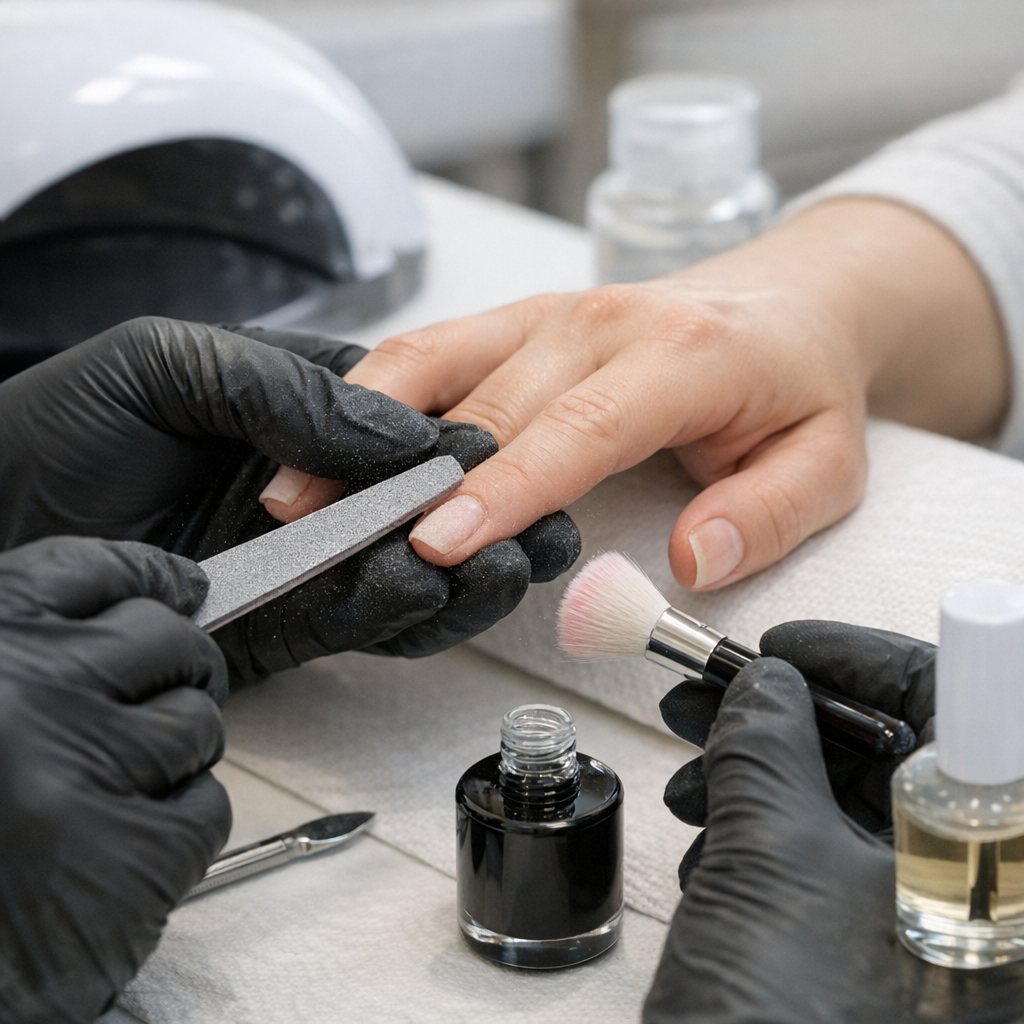
Preventing Nail Enhancement Lifting
Preventing nail enhancement lifting requires meticulous nail plate preparation, including complete cuticle removal and proper dehydration. Technicians must ensure correct liquid-to-powder ratios and avoid touching the proximal nail fold or lateral walls. Consistent application techniques and high-quality primers are essential for maintaining long-term enhancement adhesion in professional salon environments.
Essential Foundation for Adhesion
Professional Nail Plate Preparation
Success begins with removing every trace of non-living tissue from the natural nail.
Use a high-quality e-file bit or a manual pusher to clear the pterygium from the nail surface.
Failure to remove this thin layer of skin is the most common cause of early lifting.
After mechanical cleaning, use a professional-grade dehydrator to remove surface oils.
In high-humidity areas like Florida or Houston, applying dehydrator twice ensures the nail is perfectly dry.
Avoid touching the nail plate with your fingers after this step to prevent re-contaminating the surface.
The Role of Chemical Primers
Choose the correct primer based on the client’s nail type and the specific product line used.
Acid-based primers create a physical etched surface, while acid-free primers act like double-sided tape.
Ensure the primer does not flood the cuticle area, as this can lead to chemical irritation and product failure.
Advanced Application Techniques
Controlling the Liquid-to-Powder Ratio
Managing the monomer and polymer ratio is critical for structural integrity.
Beads that are too wet will experience excessive shrinkage during polymerization, pulling away from the edges.
Conversely, beads that are too dry will fail to wet the nail plate, preventing a secure bond.
Professional technicians in busy New York salons often practice bead consistency to speed up service.
Always wipe your brush between applications to prevent contaminated liquid from returning to the dappen dish.
Consistency ensures that the finished nail enhancement remains flexible yet durable enough for daily wear.
Zone Application and Margin Control
Never apply acrylic or gel directly against the skin or the eponychium.
Maintain a tiny margin, roughly the thickness of a hair, between the product and the soft tissue.
This prevents the product from “trapping” moisture or oils that naturally emerge from the skin folds.
Troubleshooting Common Service Failures
Identifying Cuticle Area Lifting
If lifting occurs primarily at the base, evaluate your cuticle work and product thickness.
Product applied too thickly in Zone 3 creates a ledge that catches on hair and clothing.
Ensure you taper the enhancement to a “flush” finish near the skin for a seamless transition.
Solving Free Edge Separation
Lifting at the free edge often stems from a failure to cap the tip or natural nail shrinkage.
If the client’s natural nails are prone to curling, consider using a rigid hard gel or an acrylic overlay.
Regular maintenance appointments in California salons help catch these issues before they lead to full nail breakage.
Environmental and Client Factors
Consider the client’s lifestyle and occupation when selecting the enhancement type.
Frequent exposure to cleaning chemicals or water without gloves will degrade even the best professional bond.
Educate clients on proper aftercare to protect the integrity of the service and your reputation as a technician.
