

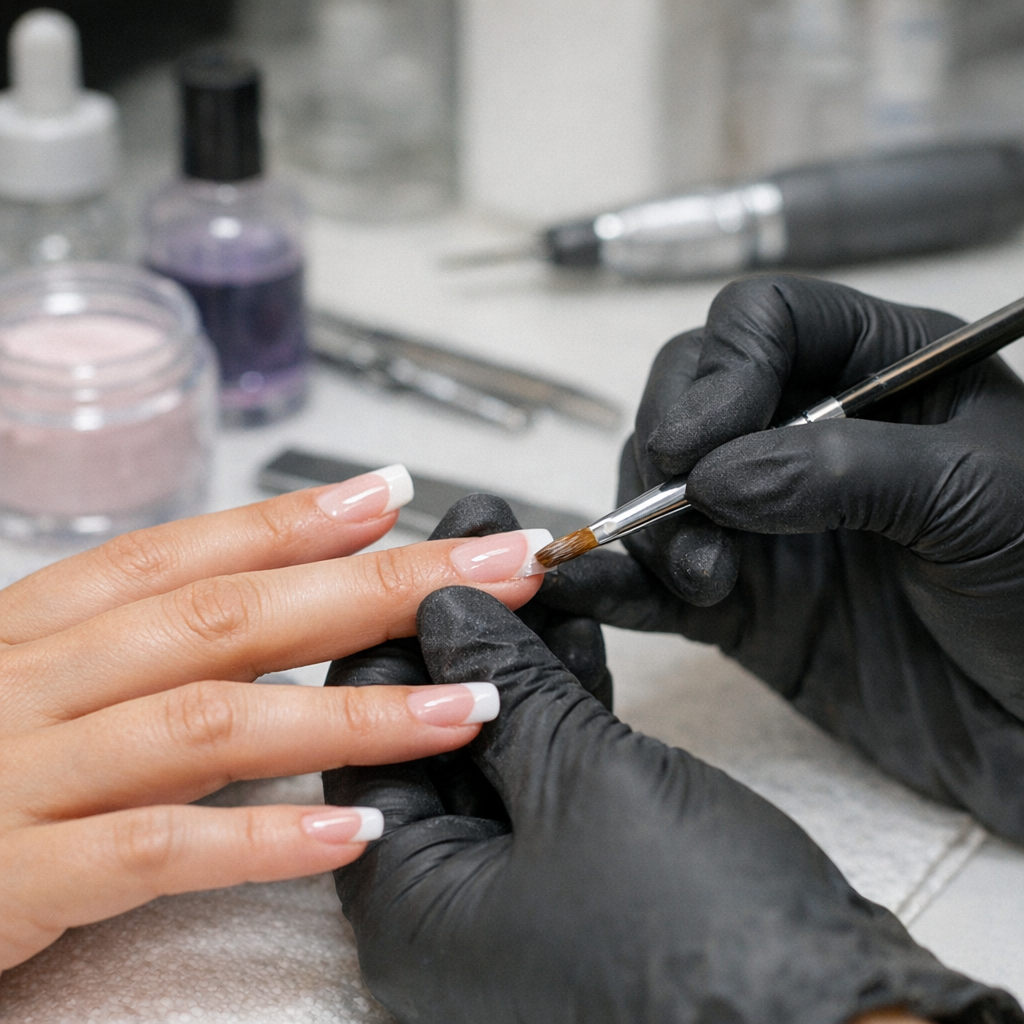
Preventing Acrylic Nail Lifting: Pro Tips & Solutions
Preventing acrylic nail lifting requires thorough natural nail plate preparation, including cuticle removal and dehydration. Technicians must ensure proper liquid-to-powder ratios and avoid touching the skin or cuticle area during application. These best practices create a strong mechanical bond, preventing moisture or oils from compromising the acrylic’s adhesion to the nail.
Essential Nail Plate Preparation Techniques
Proper preparation is the foundation of every durable nail service.
In high-volume salons in Houston, Texas, technicians often fail
to remove the invisible true cuticle from the nail plate.
Use a high-quality pusher and a fine-grit sanding band.
Gently remove all non-living tissue and surface shine.
Failure to remove these oils leads to immediate lifting at the base.
Mechanical and Chemical Dehydration
After mechanical prep, use a professional-grade dehydrator.
This step removes oils and balances the pH of the natural nail.
Apply a high-quality primer to ensure the acrylic monomer bonds securely.
Technicians in California often prefer acid-free primers for sensitive clients.
Ensure the primer does not touch the surrounding skin.
Contamination from skin oils will immediately cause edge lifting.
Application Best Practices to Avoid Lifting
The liquid-to-powder ratio is critical for product stability.
A bead that is too wet will shrink as it cures.
This shrinkage pulls the acrylic away from the natural nail edges.
Conversely, a bead that is too dry will not bond correctly.
The product will appear chalky and brittle upon finishing.
Practice consistent bead control to maintain the integrity of the enhancement.
Managing the Eponychium and Sidewalls
Leave a tiny margin between the acrylic and the skin.
If the product touches the eponychium, it creates a ledge.
As the nail grows, this ledge catches on hair and clothing.
In humid climates like Florida, this gap is even more vital.
Moisture can easily become trapped under lifted product.
This creates an environment for bacterial growth and green stains.
Troubleshooting Common Adhesion Issues
If lifting occurs at the free edge, check your filing technique.
Ensure the natural nail is not separating from the product underneath.
Always seal the edges with the acrylic bead during application.
Check the age of your monomer and polymer powders.
Contaminated monomer often results in poor polymerization and weak bonds.
Store your chemicals in a cool, dark place to prevent degradation.
Client Aftercare and Maintenance
Educate your clients on the importance of using cuticle oil daily.
Hydrated natural nails are more flexible and less likely to pull away.
Advise clients against using their nails as tools to prevent mechanical lifting.
Recommend regular maintenance appointments every two to three weeks.
Promptly filling the regrowth area prevents the enhancement from becoming top-heavy.
Proper balance and structure are essential for long-term nail durability.
