

Preventing Acrylic Nail Lifting: Professional Best Practices
Lifting is one of the most frequent challenges faced by nail technicians in the United States.
It occurs when the acrylic enhancement separates from the natural nail plate, creating a gap that traps moisture.
This issue compromises the structural integrity of the set and can lead to bacterial growth.
Understanding the root causes of lifting is essential for maintaining a high standard of service.
Whether you are working in a busy salon in New York or a private studio in Florida,
consistent results depend on mastering prep and application techniques.
Understanding the Primary Causes of Lifting
The most common cause of premature lifting is inadequate preparation of the natural nail.
Residual oils, lotion, or invisible cuticle left on the nail plate act as a barrier to adhesion.
Without a perfectly clean surface, the acrylic monomer cannot bond effectively to the keratin.
Improper Liquid-to-Powder Ratio
Working with a bead that is too wet or too dry significantly affects the durability of the enhancement.
A wet bead shrinks excessively during polymerization, pulling away from the sidewalls and cuticle area.
Conversely, a dry bead lacks the necessary chemical bond to “grip” the natural nail surface.
Cuticle Flooding and Product Overlap
Many nail technicians accidentally allow the product to touch the surrounding skin or eponychium.
As the natural nail grows out, any acrylic attached to the skin will inevitably pull up.
This creates a ledge that catches on hair and clothing, leading to immediate mechanical lifting.
Professional Solutions for Maximum Adhesion
Successful nail salons in California prioritize a thorough dry manicure as the foundation for every set.
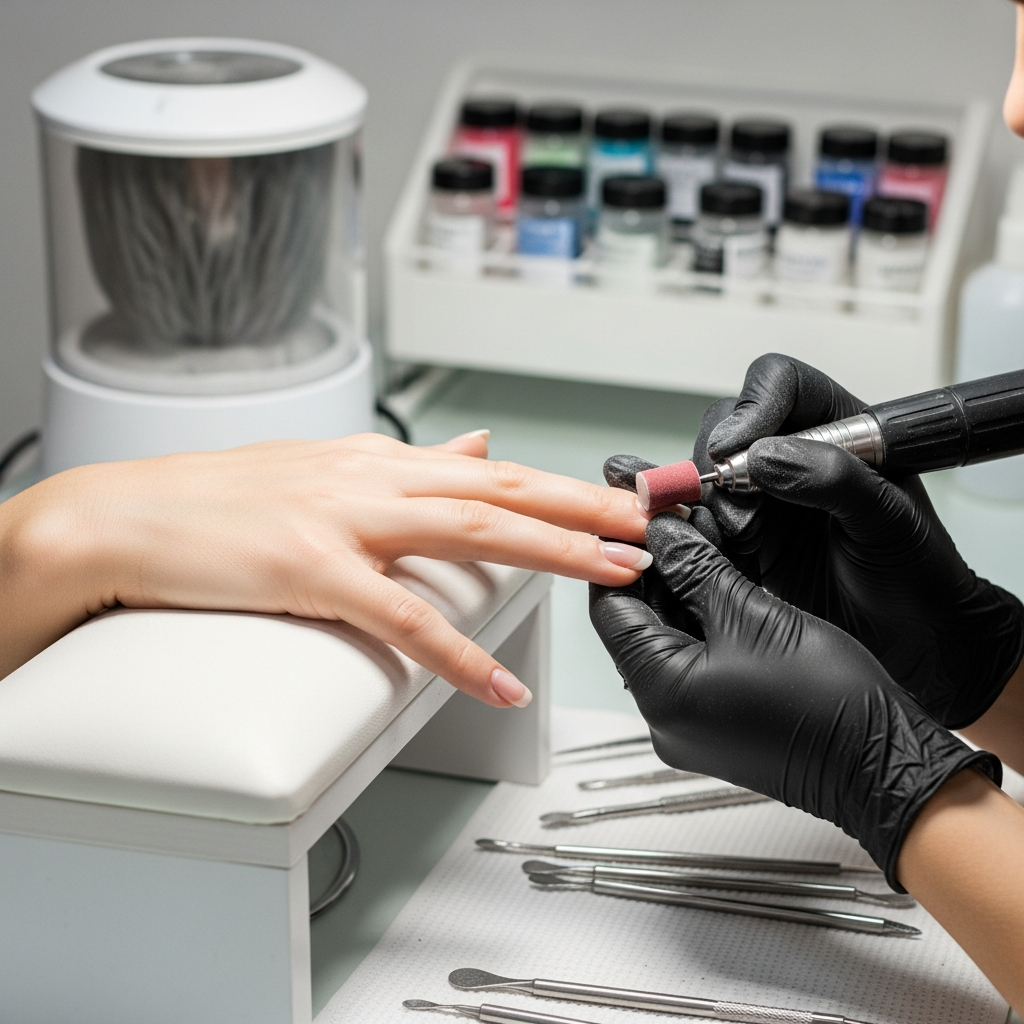
Using a fine-grit sanding band or a hand file, gently remove the shine from the entire nail plate.
Ensure you reach the tight corners near the proximal nail fold where oil tends to accumulate.
Advanced Dehydration and Priming
Applying a high-quality dehydrator is a non-negotiable step in professional nail workflows.
Follow this with a protein bonder or acid-free primer, depending on the client’s specific nail chemistry.
This step creates a double-sided adhesive bond that prepares the plate for the acrylic application.
Perfecting Bead Placement and Margin Control
Always leave a tiny margin, approximately the thickness of a hair, between the product and the skin.
Press and smooth the acrylic thin at the cuticle area to ensure a seamless transition as the nail grows.
This “tapered” effect prevents the product from catching and lifting during daily activities.
Troubleshooting Environmental and Chemical Factors
Sometimes lifting occurs despite perfect application due to external factors like chemical exposure.
Advise clients in Texas to wear gloves when using cleaning agents or frequenting swimming pools.
Chlorine and harsh detergents can break down the molecular bonds of the acrylic over time.
Monitor your salon’s temperature and humidity levels, as these affect how quickly the monomer sets.
Inconsistent salon climates can lead to crystallization or brittle acrylic, both of which contribute to cracking.
Regularly maintaining your tools and using high-quality professional systems ensures long-lasting, lifting-free results.
